We're based in Bend. We can drive to your shop, meet on a Saturday morning with nobody wondering who the visitor is, and read your numbers against a market we already understand.
- Our focus is Deschutes, Crook and Jefferson counties.
- Seasonality, labor and tourism shape value here differently than elsewhere in the state.
- Confidentiality matters more in a region this size.
Where we look
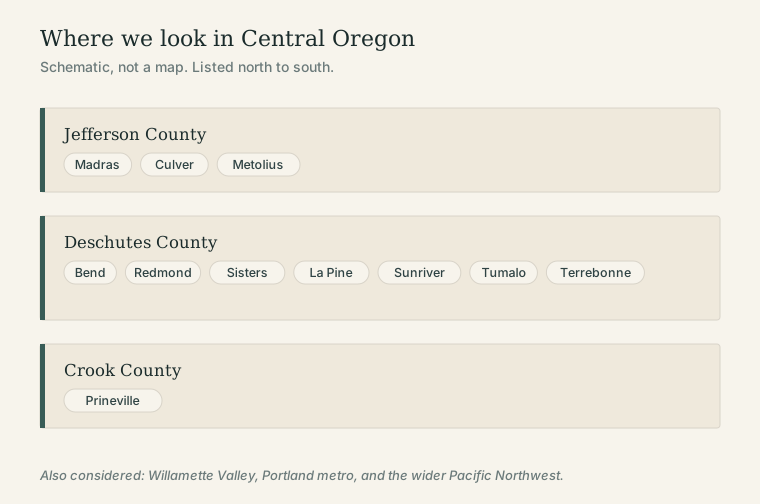
Our focus is the tri-county area and the communities around it:
- Deschutes County: Bend, Redmond, Sisters, La Pine, Sunriver, Tumalo, Terrebonne
- Crook County: Prineville and the surrounding area
- Jefferson County: Madras, Culver, Metolius
- Nearby: Warm Springs, Bend's outlying service areas, and the corridor toward Klamath and Lake counties
We also look at the Willamette Valley and the Portland metro, and we'll consider the broader Pacific Northwest for the right business. Central Oregon is home, and a business here gets our attention first.
What makes this market its own thing
A buyer who treats Central Oregon as generic Oregon will misread a business here. A few things we account for:
Seasonality is normal, not a red flag
A landscaping company, a river outfitter, a snow-removal operation, a restaurant on the west side: these revenue curves would alarm an out-of-state buyer reading quarterly numbers cold. We know what a normal Central Oregon season looks like. A slow February isn't a declining business, and we won't price it as one.
Growth has reshaped the cost base
Population growth has pushed up commercial rents, wages and housing costs, compressing margins for some businesses and expanding demand for others. Thinner margins over the last few years can still mean a healthy business. The real question is whether the cause was pricing discipline or cost inflation, and the two mean very different things for value.
Labor is the real constraint
Across trades, hospitality and healthcare, the binding limit here is usually people, not demand. A business with a stable, tenured crew is worth meaningfully more than the same business with constant turnover. It's a large part of why we keep teams in place rather than restructuring them.
Tourism cuts both ways
Visitor spending supports plenty of businesses here, and it's more volatile than local demand. We look closely at the mix: a business serving residents year-round carries a different risk profile than one dependent on summer and ski season, even at identical revenue.
Water, land use and wildfire
Irrigation district rights, Oregon's land-use rules, and wildfire exposure and insurability all affect businesses with real property or agricultural ties. Out-of-area buyers typically discover these late in diligence, which is exactly where deals stall.
Why this matters to you as a seller: a buyer who has to be taught your market takes longer, asks more questions, and discounts for uncertainty they can't resolve. A buyer who already understands it moves on the substance instead.
The kinds of businesses we look at here
We're generalists on industry, specific about characteristics. In Central Oregon that usually means home services and the trades (HVAC, plumbing, electrical, roofing, landscaping), auto and equipment services, light manufacturing and distribution, B2B services, healthcare services, and specialty retail or coffee with a genuine local following.
What matters more than category: ten or more years of operating history, a real team rather than a one-person operation, a stable customer base, and a good reputation in a region where reputation travels fast. Full criteria are on our home page.
Local resources worth knowing about
These are independent of us. We'd point you to them whether or not we ever do business together.
- The Small Business Development Center at COCC. Central Oregon Community College runs an SBDC offering confidential advising to local business owners, including on succession and exit planning. It's genuinely underused, and it costs nothing to start a conversation.
- Your chamber. The Bend Chamber and the chambers in Redmond, Sisters, Prineville, Madras and Sunriver maintain business-resource listings and can point you toward local advisors.
- A local CPA and a transaction attorney. Both should have actually worked on a business sale. We'd rather negotiate against a seller who's well advised. It makes the process faster and the outcome more durable.
A word about confidentiality in a small market
Here's the fear, named plainly: Central Oregon is a region where people know each other, and a rumor that you're selling reaches your competitors, your crew and your best customers fast. It's very hard to walk back. That's the main reason owners here delay conversations they should already be having.
It's also the argument for talking to a direct buyer instead of listing. Your information goes to one party. No listing circulates, no marketed package, no inquiries from people quietly doing competitive research. In practice, that means:
- A mutual NDA, signed before we look at financials
- Site visits outside business hours
- No contact with your employees, customers or vendors without your written permission
- You decide when your team is told, and we'll help you plan that conversation