Brokers earn their fee in plenty of situations. A lot of owners just assume one is mandatory, and it isn't.
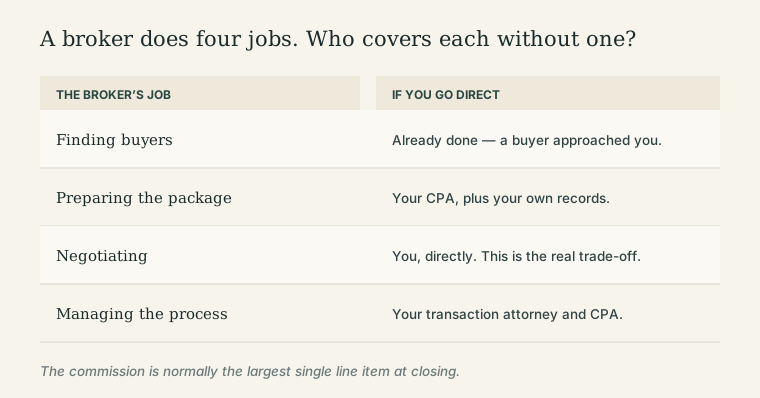
- If a buyer already found you, one of the broker's four jobs is done.
- The commission is normally the biggest line item at closing.
- Going direct has a real cost: no competitive tension.
If a buyer approaches you directly, or you approach one, you can run the whole process with your CPA and an attorney and keep the commission. Here's what you gain, what you give up, and when hiring a broker is genuinely the better call.
What a broker actually does
A good broker performs four distinct jobs. You may need some and not others:
- Finding buyers. Listing the business, screening inquiries, running a confidential marketing process.
- Preparing the package. Assembling financials, normalizing add-backs, writing the confidential information memorandum.
- Negotiating. Standing between you and the buyer, so you never have to say no to someone's face.
- Managing the process. Keeping diligence on schedule and chasing the small items that stall closings.
If a buyer already found you, job one is done. Your CPA and attorney can handle jobs two and four. Job three, the buffer, is the one worth thinking through carefully. We'll come back to it.
What it costs
Brokers are normally paid a success fee: a percentage of the sale price, often with a stated minimum and sometimes an up-front retainer. The percentage varies by broker, industry and deal size. Larger deals commonly use a tiered structure where the rate steps down as the price rises.
Ask any broker you interview to put their full fee schedule in writing, including the minimum and what triggers it. However it's calculated, the commission is typically the largest single line item at closing, bigger than legal and accounting combined.
The question that matters: will a competitive process raise your price by more than the fee? For a business with several plausible buyers, often yes. For a specialized operation with a handful of buyers who already know you exist, often no.
What you give up by going direct
Go in clear-eyed. Here's what's actually on the table:
- No competitive tension. The real one. A single buyer has no reason to bid against themselves. You lose the price discovery multiple parties create.
- No buffer. You negotiate face to face with the person who'll own your business. Some owners find that clarifying. Others find it uncomfortable, especially when the answer is no.
- No benchmark. A broker who's sold twenty businesses in your industry knows what the market pays. Without one, you need another source of comparison.
- More of your own time. Diligence requests, document gathering and scheduling land on you instead of an intermediary.
How to protect yourself without one
Three things cover most of what a broker provides:
- A transaction attorney, not your general attorney. Someone who's closed business sales before. They draft or review the LOI and purchase agreement, and they'll catch indemnification and non-compete terms a generalist misses. Ask for a fee estimate up front.
- Your CPA, before the LOI. Purchase price allocation and deal structure determine your after-tax proceeds. Bringing your accountant in after terms are agreed is the single most expensive sequencing mistake sellers make.
- An independent valuation, if the number is unclear. A formal appraisal gives you your own defensible anchor. Cheaper options: ask your industry association what comparable businesses have traded at, or talk to two or three buyers and compare how each builds their number.
Added up, that's normally a small fraction of a commission, and it covers the parts of a broker's role that actually protect you.
When you should hire a broker anyway
We'd rather tell you this plainly:
- Several buyers would compete for your business. Competition is worth more than the fee. Run the process.
- You don't want to negotiate. If discussing price with your own buyer would make you concede or stall, pay someone to sit between you.
- You genuinely don't know what it's worth. If your own guess could be off by a wide margin, the fee buys real information.
- The situation is messy. Multiple owners who disagree, pending litigation, a tangled entity history: experience pays for itself here.
- You don't have the time. Running the business while running a sale is genuinely hard. A distracted operator's numbers slip during diligence, and that costs real money.
We work with brokered sellers regularly and have no issue with a broker on the other side of the table. If you have one, fine. If you're still deciding, decide on the merits, not the assumption that one is required.
A middle path
You don't have to pick all-or-nothing. Hire an attorney and CPA, talk to two or three direct buyers yourself, and only bring in a broker if those conversations don't land on a number you like.
That first round costs you a few conversations and an NDA. Work out, and you've saved the commission. Doesn't work out, you've lost a little time and learned what the market actually thinks, which makes you a sharper client when you do hire someone.