Valuation looks like a dark art. It mostly isn't.
- Two questions set the price: what the business earns, and how risky that earning is.
- Add-backs have to be documentable, or they don't survive diligence.
- The headline price and your actual proceeds are two different numbers.
For businesses under roughly $10 million, it comes down to those two questions. The first gives you a number (SDE). The second gives you a multiple. Multiply them and you have a starting point.
Step one: what the business really earns
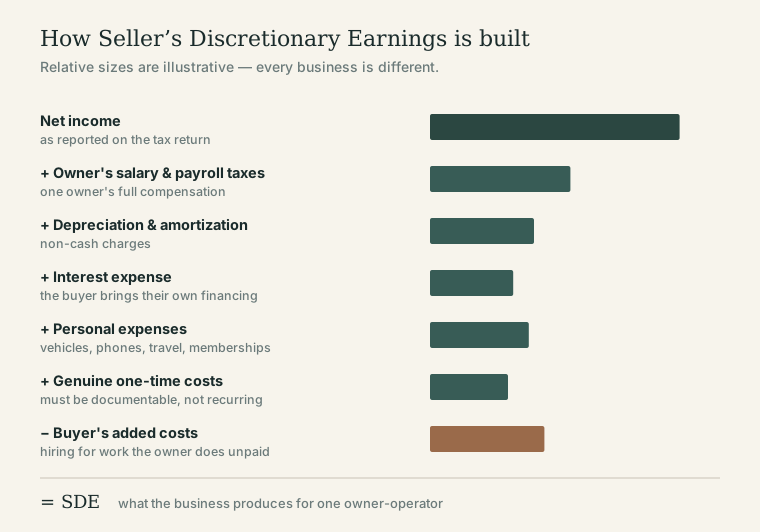
Your tax return understates your earnings, deliberately and legally. A good accountant has spent years minimizing taxable income. Valuation reverses that to find what the business generates for a single owner-operator: Seller's Discretionary Earnings, or SDE.
Start with net income on the tax return and add back:
- Your own salary and payroll taxes: one owner's full compensation
- Depreciation and amortization: non-cash charges
- Interest expense: the buyer brings their own financing
- Personal expenses run through the business: vehicles, phones, travel, memberships, family on payroll who don't work there
- Genuine one-time costs: a resolved lawsuit, a roof replaced, a failed software rollout
Then subtract what the buyer picks up that you don't. The common one: if you work sixty hours doing two people's jobs, a buyer needs to hire for the half you won't be doing. That cost comes out.
As earnings grow, buyers shift from SDE to EBITDA, which skips the owner-compensation add-back because the business is assumed to pay a market-rate manager at that size. Same business, higher SDE, lower EBITDA. The two multiples aren't interchangeable. Confirm which one a quoted multiple refers to.
Add-backs get negotiated, not declared. Every one needs to be documentable and defensible. A buyer accepts your truck. They push back on "one-time" expenses that show up three years running. Overreach here, and it costs you credibility across the whole deal.
Step two: the multiple
The multiple measures risk and durability. It varies widely by industry, and larger businesses generally carry higher multiples because they can support professional management and more debt.
We won't quote a range here. A number on a website tells you nothing about your business, and anchoring on one before anyone's looked at your financials does you no favors. Here's what actually moves it.
Pushes it up:
- Recurring revenue. Contracts, service plans, maintenance agreements. Predictable money beats the same amount of unpredictable money.
- A diversified customer base. No single customer carrying an outsized share of revenue.
- A management layer. Someone besides you who runs the day to day.
- Documented processes. Written procedures, a real CRM or job-management system, clean records.
- Growth. Three years of rising revenue and stable margins.
- A stable team. Low turnover, key people under agreement.
Pulls it down:
- Owner dependence. The biggest factor in this size range. If the relationships, pricing judgment and technical knowledge live in your head, much of the value walks out with you.
- Customer concentration. One account carrying a large share of revenue is a real risk, and gets priced as one.
- Declining revenue. Two down years turns the conversation from a multiple of earnings into a conversation about why.
- Messy books. Cash transactions that don't appear anywhere, commingled accounts, reconciliations that don't tie.
- Deferred maintenance. A dollar-for-dollar deduction, plus a discount for the hassle.
- Lease or location risk. A short term with no option, or a landlord who won't assign it.
What's actually included in the number
A quoted price almost always assumes the business transfers debt-free and cash-free, with normal working capital in place:
| Usually included | Usually not |
|---|---|
| Equipment and vehicles in working order | Cash in the business bank account |
| Normal inventory levels | Accounts receivable (often, though it varies) |
| Customer relationships and goodwill | Business debt, paid off at closing from proceeds |
| The name, phone number, website and records | Real estate, valued and sold or leased separately |
Real property surprises people most. Own your building? It's a second asset with its own value. Some sellers sell both. Many keep the building and lease it to the buyer, turning it into retirement income. Either works, but price the two separately so you can see what each is actually worth.
Price isn't proceeds
What matters is what lands in your account after taxes, not the headline on the LOI. A higher price with a bad allocation can net you less than a lower price structured well.
Three things drive that gap: how the price is allocated across asset classes, how much is paid at closing versus over time, and your own basis and tax situation. Loop in your CPA before you agree to terms, not after. We're not accountants and can't advise on your tax position, but we'll flag when a structure has consequences worth asking about.
How we actually do it
We walk you through the arithmetic in plain language: the SDE we calculated, the add-backs we accepted (and the ones we didn't, and why), the multiple we applied and what moved it, the structure and what it means for your timing. No number arrives without the reasoning behind it.
Disagree with a piece of it? Say so. You may know something about the business that isn't visible in the financials, and that changes our math. A valuation conversation that ends with you understanding exactly how the number was built is worth having, even if you don't sell for another five years.