You built this business over years, maybe decades. Selling it well means protecting the people who show up Monday morning and the name on your sign, not just landing a good number.
- The sequence is the same for every deal. Only the pace changes.
- Oregon adds a few tax and licensing wrinkles worth knowing early.
- Most deals die over preparation, not price.
Seven steps, start to finish
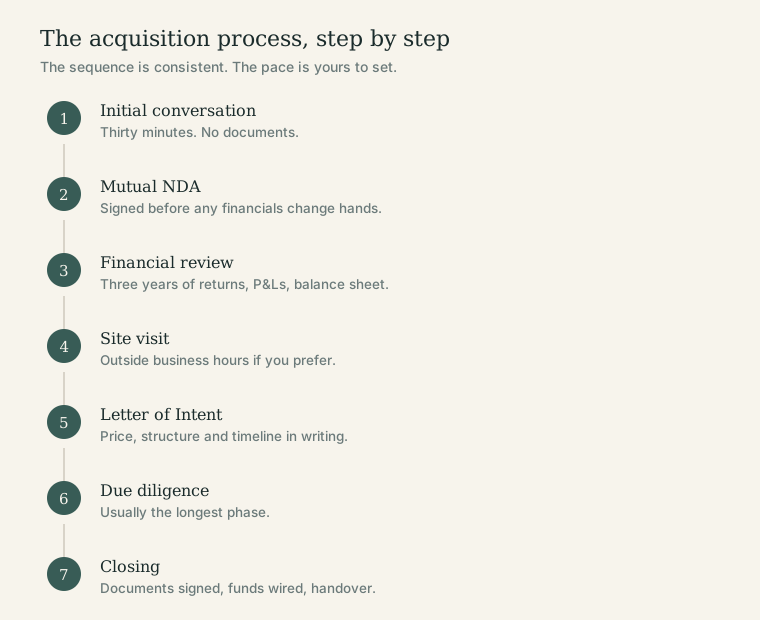
These steps are consistent across the lower middle market. You set the pace. The sequence doesn't change, the speed does.
- Initial conversation. Thirty minutes, no documents. What the business does, why you're thinking about a change, and what you want the outcome to look like.
- Mutual NDA. Signed before any financials change hands. It protects you, and it protects anything we tell you.
- Financial review. Three years of tax returns and P&Ls, plus a current balance sheet.
- Site visit. After hours or on a weekend, so nobody has to explain who the visitor is.
- Letter of Intent. Non-binding on price, binding on exclusivity. The number, the structure and the timeline get written down here.
- Due diligence. Usually the longest phase: contracts, leases, equipment, customer records, employment agreements, insurance, environmental if there's real property.
- Closing. Documents signed, funds wired, keys handed over. Often followed by a short transition where you stay on.
Due diligence is where deals actually get tested. Unprepared sellers lose time and price here. Clean books, written processes and current contracts shrink this phase dramatically.
What Oregon adds to the deal
Your negotiated terms govern most of a sale. A handful of Oregon rules still matter:
- No state sales tax. Oregon has none, which removes a layer of transfer complexity sellers in Washington or California deal with.
- The Corporate Activity Tax. Oregon's CAT applies to commercial activity above a threshold and can touch the deal depending on structure. Raise it with your CPA early.
- State income tax on the gain. Oregon taxes capital gains as ordinary income. Asset sale versus stock sale, and how the price is allocated across asset classes, can move your after-tax proceeds meaningfully. Loop in your CPA before you sign the LOI.
- Licensing and permits. Construction contractor (CCB), liquor, and health permits don't always transfer automatically. Some require the buyer to qualify independently, which affects timing.
- Employment practices. Oregon has its own sick leave, scheduling and final-paycheck rules. A buyer keeping your team plans for continuity on accrued balances.
None of this is legal or tax advice. We're not attorneys or accountants, and your situation will differ from the examples here. Get your own CPA and an attorney who's closed business sales before.
Asset sale or stock sale
Almost every deal under $10M is an asset sale: the buyer gets your equipment, inventory, customer relationships, name and goodwill. The legal entity stays yours to wind down afterward.
| Asset sale | Stock sale | |
|---|---|---|
| Who prefers it | Buyers | Sellers |
| Liability | Mostly stays with you | Transfers to the buyer |
| Tax treatment | Allocated across asset classes; some portion often taxed as ordinary income | Generally capital gains on the whole |
| Contracts & licenses | Often need reassignment or re-issue | Usually carry over |
| Typical in this range | Yes, the large majority | Occasionally, usually for licensing reasons |
Here's where you actually have leverage: the allocation inside the asset sale. Shifting dollars between equipment, goodwill and a non-compete changes your tax bill without touching the sale price.
The paperwork you'll need
Quick readiness test: how long would it take you to pull this together?
- Three years of business tax returns and P&Ls, plus year-to-date
- A current balance sheet and an accounts-receivable aging report
- An equipment and vehicle list, with age and condition
- Your lease, or details of the real property if you own it
- Customer concentration: what share of revenue your top five bring in
- A roster: roles, tenure, pay, and who'd be hard to replace
- Any recurring contracts, service agreements or maintenance plans
- Add-backs: owner compensation, personal vehicles, one-time expenses
A weekend to gather it? You're ready. Six months? Start the conversation now. Preparation is what moves your price.
Where sales fall apart
Your deal won't die over price. It'll die over:
- Books that don't reconcile. When the tax return and the P&L tell different stories, every number becomes negotiable.
- Customer concentration. One big client is a discount, not a dealbreaker, if you disclose it early. Buyers who discover it themselves walk.
- Owner dependence. If every quote, every key relationship and every decision runs through you, a buyer is purchasing a job, not a business.
- Lease surprises. A short term with no renewal option, found during diligence, can reset the whole deal.
- Deferred maintenance. Equipment at end of life shifts cost to the buyer and comes straight out of price.
Every one of these is fixable with lead time. None of them is fixable once the LOI is signed and the clock is running.
Confidentiality
Here's the fear, named plainly: word gets out, your best people start job hunting, and competitors start calling your customers.
Selling directly closes that leak. Your information goes to one buyer, not a mailing list of shoppers. In practice, that means:
- A mutual NDA, signed before we see your financials
- Site visits outside business hours
- Zero contact with your staff, customers or vendors without your written OK
- You decide when and how your team hears about it